
Free lean posters
Nineteen printable A4 posters, one per lean tool — 5S, the eight wastes, OEE, takt, gemba walks and more. The same ones Lean Day Toolkit prints from inside the app.
Each poster says what the tool is for, shows the four steps that make it work, and ends with the one line to remember. Pick one to see everything it says, or download the PDF straight away.
-
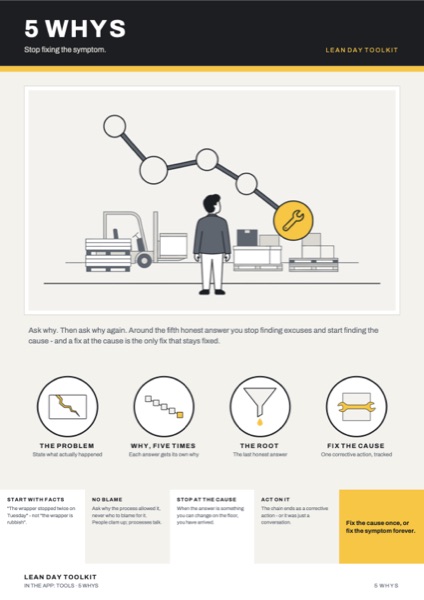
5 Whys
Stop fixing the symptom.
Ask why. Then ask why again. Around the fifth honest answer you stop finding excuses and start finding the cause - and a fix at the cause is the only fix that stays fixed.
"Fix the cause once, or fix the symptom forever."
-
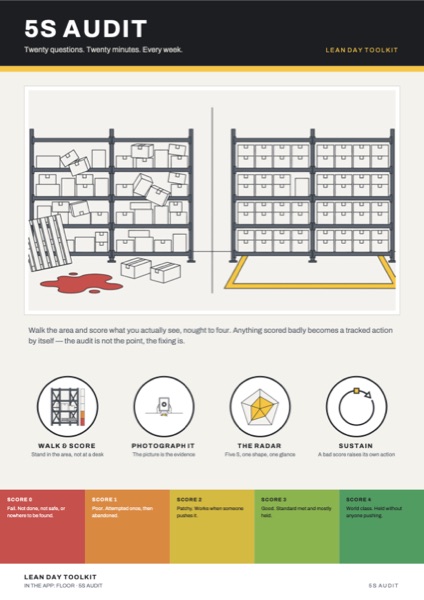
5S Audit
Twenty questions. Twenty minutes. Every week.
Walk the area and score what you actually see, nought to four. Anything scored badly becomes a tracked action by itself — the audit is not the point, the fixing is.
-
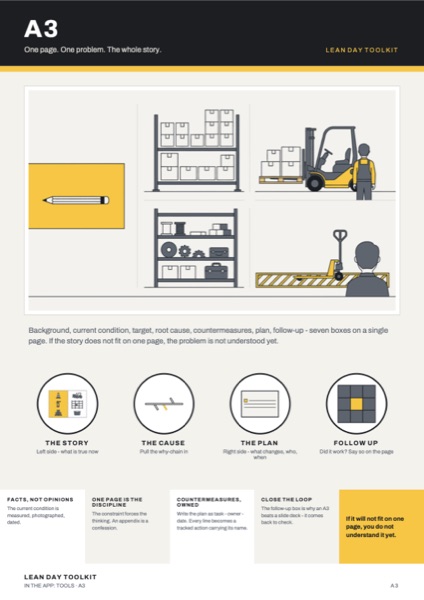
A3
One page. One problem. The whole story.
Background, current condition, target, root cause, countermeasures, plan, follow-up - seven boxes on a single page. If the story does not fit on one page, the problem is not understood yet.
"If it will not fit on one page, you do not understand it yet."
-
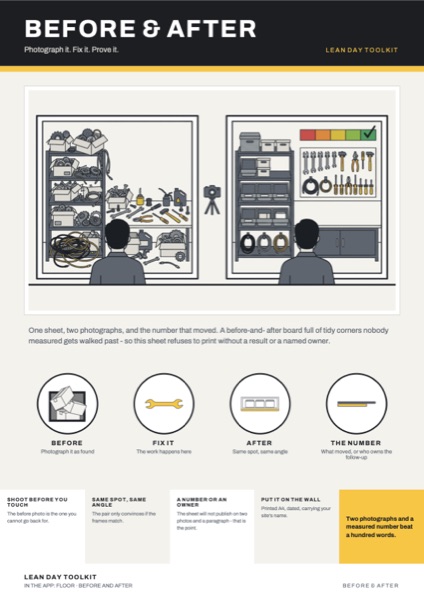
Before & After
Photograph it. Fix it. Prove it.
One sheet, two photographs, and the number that moved. A before-and- after board full of tidy corners nobody measured gets walked past - so this sheet refuses to print without a result or a named owner.
"Two photographs and a measured number beat a hundred words."
-
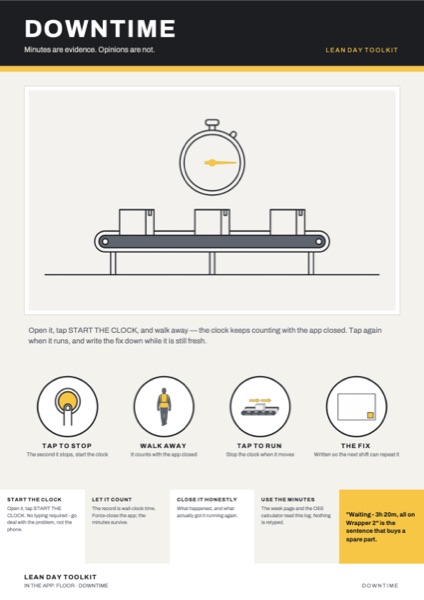
Downtime
Minutes are evidence. Opinions are not.
Open it, tap START THE CLOCK, and walk away — the clock keeps counting with the app closed. Tap again when it runs, and write the fix down while it is still fresh.
""Waiting - 3h 20m, all on Wrapper 2" is the sentence that buys a spare part."
-
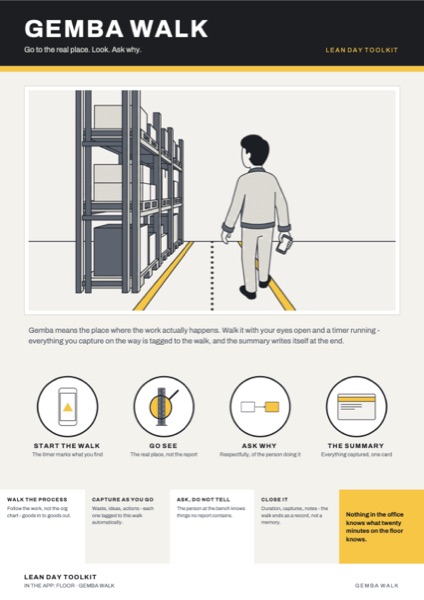
Gemba Walk
Go to the real place. Look. Ask why.
Gemba means the place where the work actually happens. Walk it with your eyes open and a timer running - everything you capture on the way is tagged to the walk, and the summary writes itself at the end.
"Nothing in the office knows what twenty minutes on the floor knows."
-
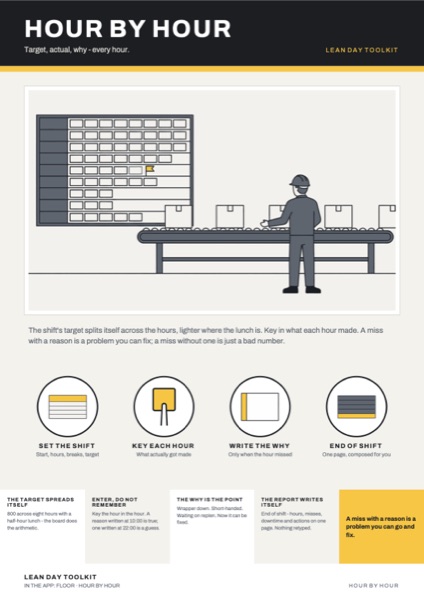
Hour by Hour
Target, actual, why - every hour.
The shift's target splits itself across the hours, lighter where the lunch is. Key in what each hour made. A miss with a reason is a problem you can fix; a miss without one is just a bad number.
"A miss with a reason is a problem you can go and fix."
-
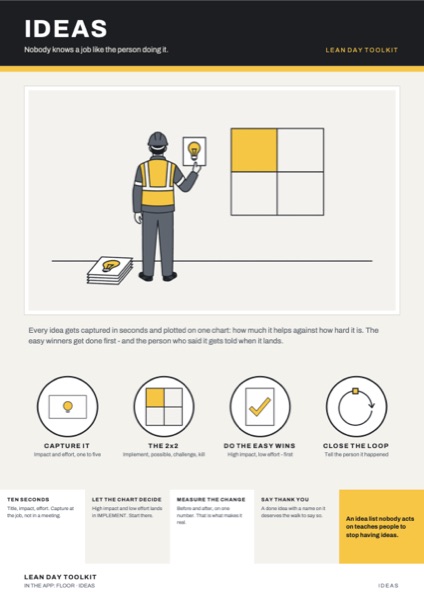
Ideas
Nobody knows a job like the person doing it.
Every idea gets captured in seconds and plotted on one chart: how much it helps against how hard it is. The easy winners get done first - and the person who said it gets told when it lands.
"An idea list nobody acts on teaches people to stop having ideas."
-
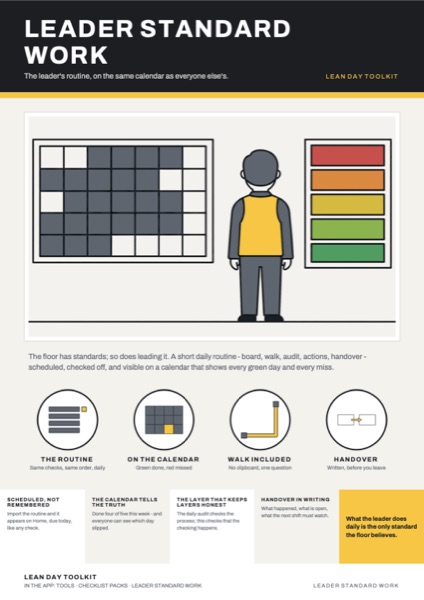
Leader Standard Work
The leader's routine, on the same calendar as everyone else's.
The floor has standards; so does leading it. A short daily routine - board, walk, audit, actions, handover - scheduled, checked off, and visible on a calendar that shows every green day and every miss.
"What the leader does daily is the only standard the floor believes."
-
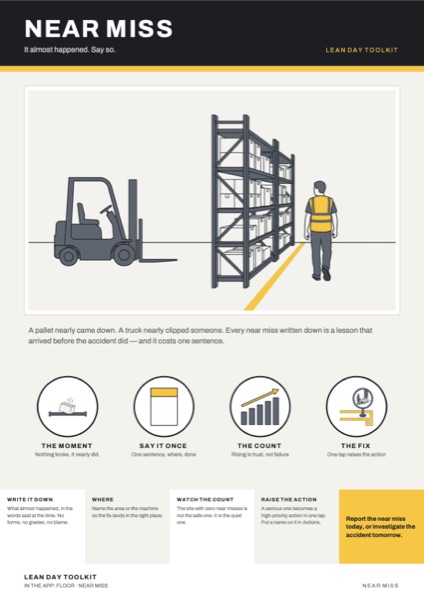
Near Miss
It almost happened. Say so.
A pallet nearly came down. A truck nearly clipped someone. Every near miss written down is a lesson that arrived before the accident did — and it costs one sentence.
"Report the near miss today, or investigate the accident tomorrow."
-
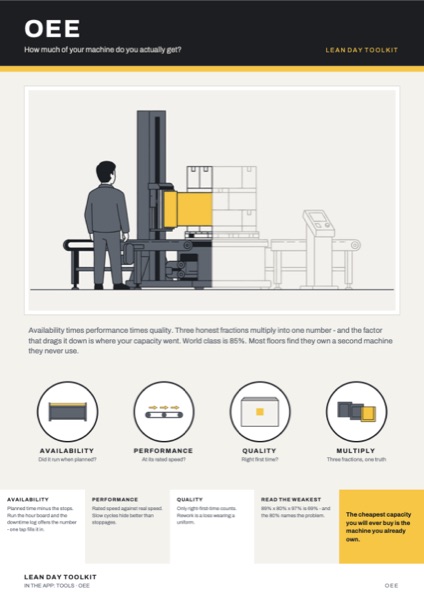
OEE
How much of your machine do you actually get?
Availability times performance times quality. Three honest fractions multiply into one number - and the factor that drags it down is where your capacity went. World class is 85%. Most floors find they own a second machine they never use.
"The cheapest capacity you will ever buy is the machine you already own."
-
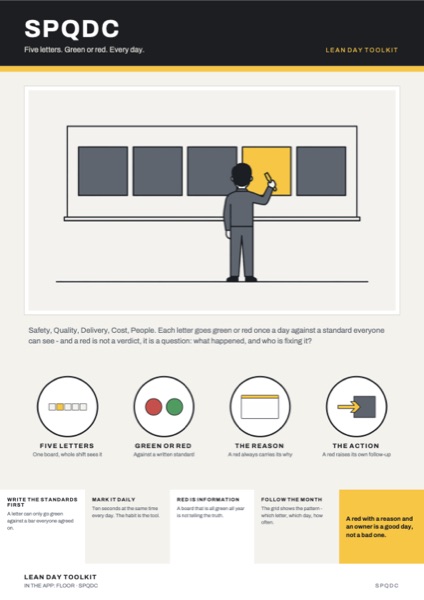
SPQDC
Five letters. Green or red. Every day.
Safety, Quality, Delivery, Cost, People. Each letter goes green or red once a day against a standard everyone can see - and a red is not a verdict, it is a question: what happened, and who is fixing it?
"A red with a reason and an owner is a good day, not a bad one."
-
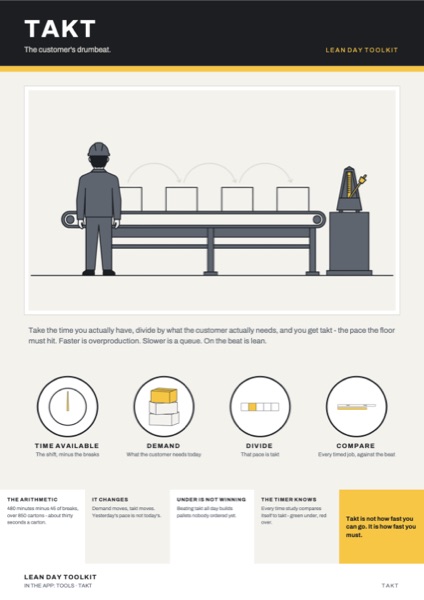
Takt
The customer's drumbeat.
Take the time you actually have, divide by what the customer actually needs, and you get takt - the pace the floor must hit. Faster is overproduction. Slower is a queue. On the beat is lean.
"Takt is not how fast you can go. It is how fast you must."
-
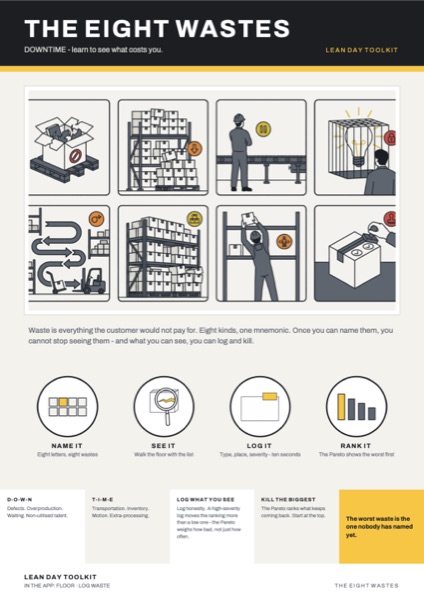
The Eight Wastes
DOWNTIME - learn to see what costs you.
Waste is everything the customer would not pay for. Eight kinds, one mnemonic. Once you can name them, you cannot stop seeing them - and what you can see, you can log and kill.
"The worst waste is the one nobody has named yet."
-
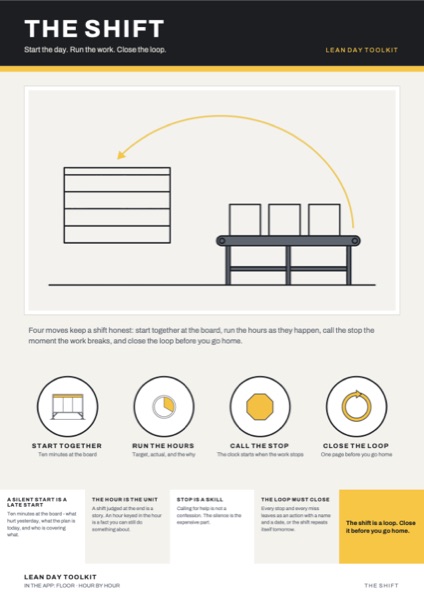
The Shift
Start the day. Run the work. Close the loop.
Four moves keep a shift honest: start together at the board, run the hours as they happen, call the stop the moment the work breaks, and close the loop before you go home.
"The shift is a loop. Close it before you go home."
-
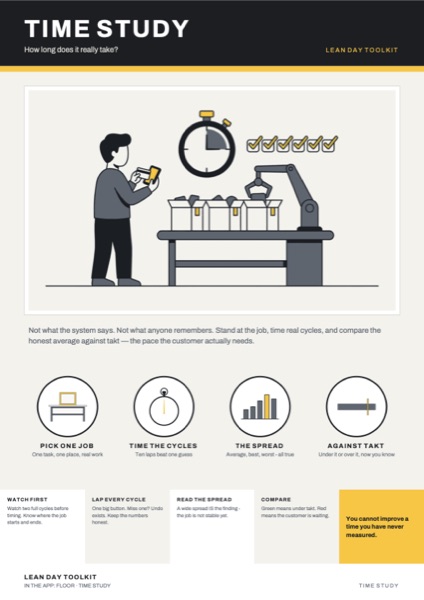
Time Study
How long does it really take?
Not what the system says. Not what anyone remembers. Stand at the job, time real cycles, and compare the honest average against takt — the pace the customer actually needs.
"You cannot improve a time you have never measured."
-
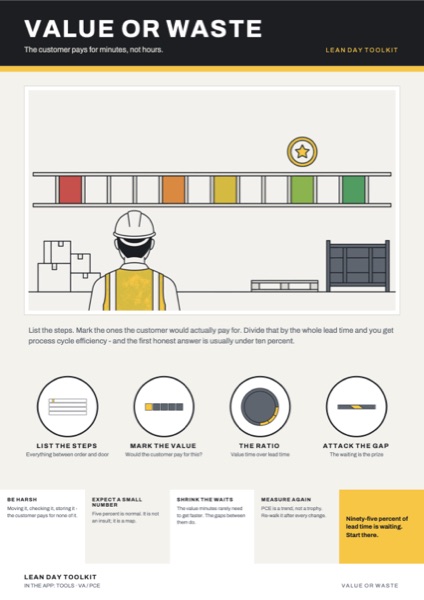
Value or Waste
The customer pays for minutes, not hours.
List the steps. Mark the ones the customer would actually pay for. Divide that by the whole lead time and you get process cycle efficiency - and the first honest answer is usually under ten percent.
"Ninety-five percent of lead time is waiting. Start there."
-
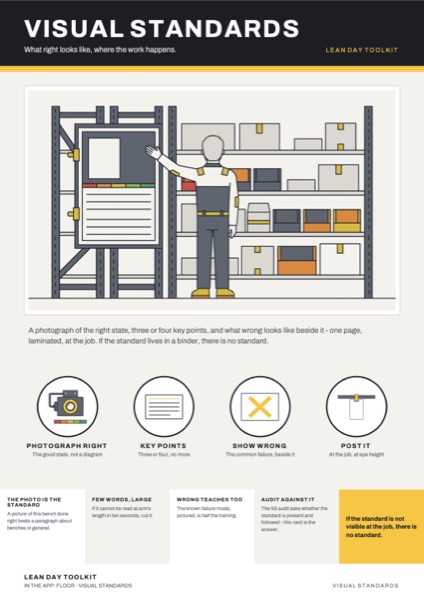
Visual Standards
What right looks like, where the work happens.
A photograph of the right state, three or four key points, and what wrong looks like beside it - one page, laminated, at the job. If the standard lives in a binder, there is no standard.
"If the standard is not visible at the job, there is no standard."
-
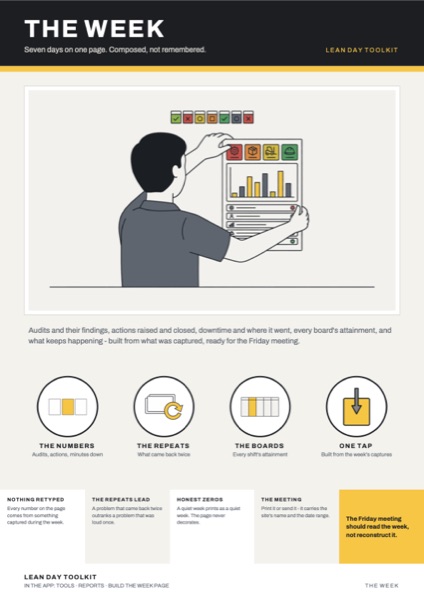
The Week
Seven days on one page. Composed, not remembered.
Audits and their findings, actions raised and closed, downtime and where it went, every board's attainment, and what keeps happening - built from what was captured, ready for the Friday meeting.
"The Friday meeting should read the week, not reconstruct it."
Every one of these tools is in the app, with a button from the poster into the tool that does the thing. Lean Day Toolkit on the App Store. Lean Day Toolkit on Google Play. Lean Day Toolkit on the Amazon Appstore.
Questions
Are the posters really free?
Yes. Free to download, print and use in your own workplace. Please don't resell them or strip the credit.
What size are they?
Each poster is a one-page A4 PDF. On US Letter paper, print it with "Fit to page".
Do I need the app to use them?
No. Each poster works on its own on a noticeboard. Lean Day Toolkit has the tool behind every poster, and prints the same posters from inside the app.