An SPQDC board is a simple daily scoreboard for a team: Safety, People, Quality, Delivery and Cost. Once a day, each letter is marked green if the day met its standard and red if it didn't. Every red gets a short reason and someone who will follow it up. The board takes seconds to update and shows the whole team, at a glance, how yesterday went and what is being done about it.
What each letter means
| Letter | The question | An example standard |
|---|---|---|
| S — Safety | Did anyone get hurt, or nearly hurt? | No injuries and no unreported near misses |
| P — People | Did the team have what it needed? | Fully staffed, and everyone on the job trained for it |
| Q — Quality | Did the work come out right first time? | No customer complaints, and rework under the agreed limit |
| D — Delivery | Did it go out on time? | Every order due today shipped today |
| C — Cost | Did it cost what it should? | No overtime or scrap beyond the plan |
The standards here are examples. Write your own, in plain words, for your area.
SPQDC, SQDCP or SQDC?
They are the same idea in a different order. Many sites use SQDC, or SQDCP with People added at the end. Lean Day Toolkit uses SPQDC, putting People second, straight after Safety. The order is a choice about what the team talks about first. What matters is that everyone uses the same letters every day.
How to run it
- Write the standards first. A letter can only go green against a bar everyone agreed on. If nobody can say what green means for Cost, it will be marked green out of habit.
- Mark it daily, at the same time. The poster puts it as
Ten seconds at the same time every day. The habit is the tool.
Many teams mark it at the start-of-shift meeting. - Give every red a reason and an owner. "Delivery red: two orders short because the label printer was down, Sam to chase the service call." Now it can be fixed.
- Look at the month, not just today. A grid of the month shows the pattern: which letter goes red, on which day of the week, and how often.
Red is information
A board that is green every day for a year is almost never telling the truth. Either the
standards are too loose or the reds aren't being written down, often because a red feels like
blame. The poster's line is the one to keep: A red with a reason and an owner is a good day, not
a bad one.
If a red brings questions about the process, people will mark it honestly. If it
brings blame, they won't.
A free SPQDC poster for the board
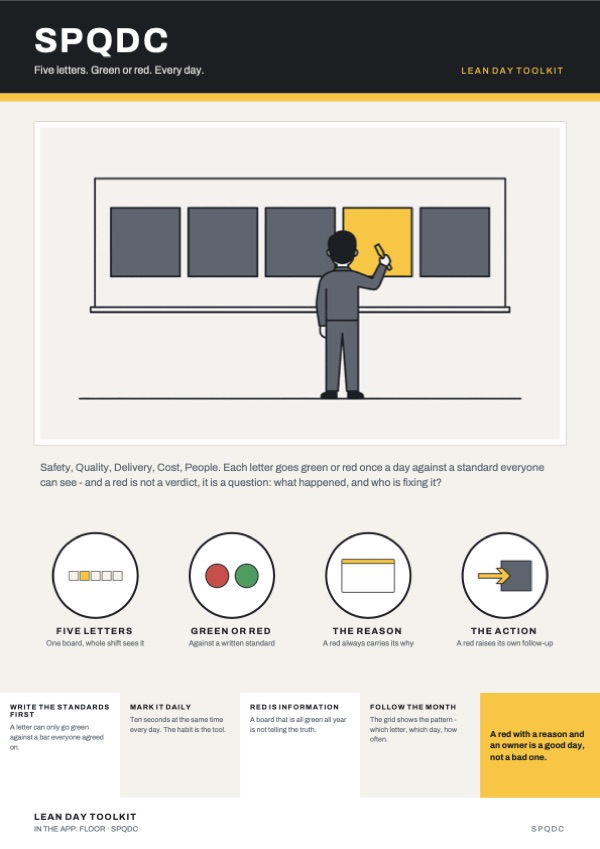
The SPQDC poster puts the five letters and the four rules on one A4 page. It is free to download, print and pin up next to the board. It is one of 19 free lean posters; the Hour by Hour and Shift posters cover the rest of the daily routine.
SPQDC in Lean Day Toolkit
Lean Day Toolkit has an SPQDC board under Floor → SPQDC, in the full version of the app. Each letter is marked green or red for the day, a red carries its reason and raises its own follow-up action, and the month's grid shows the pattern. Any red's action lands in the app's action list, alongside the actions from 5S audits and 5 Whys.
Related: How to run a 5 Whys, for a red that keeps coming back.