The 5 Whys is a way of finding the cause of a problem by asking "why?" about it, then asking "why?" about the answer, and carrying on until you reach something you can change. It takes a few minutes, needs no software and works best standing where the problem happened. Five is a rule of thumb, not a quota: you stop when you reach the cause, whether that is the third answer or the sixth.
Problem → why? → why? → why? → why? → why? → the cause → one action
Where it comes from
The method is part of the Toyota Production System. Taiichi Ohno, who built that system, described it in his book Toyota Production System with a machine that had stopped: the fuse blew because of an overload, the overload came from a bearing that wasn't lubricated, the bearing wasn't lubricated because the pump wasn't pumping enough, the pump wasn't pumping because its shaft was worn, and the shaft was worn because there was no strainer and metal scrap got in. Replacing the fuse would have fixed the first answer. Fitting a strainer fixed the fifth, and the machine stopped stopping.
A worked example
Here is a chain from a packing area. It is an illustration, built on the example the Lean Day Toolkit poster uses.
- The problem: the wrapper stopped twice on Tuesday.
- Why did it stop? The film snapped both times.
- Why did the film snap? The pallets were wrapped with too much tension.
- Why was the tension too high? The wrapper was on the setting for heavy pallets, and Tuesday's orders were light.
- Why was it on the heavy setting? Nobody changes the setting when the product changes, because nobody was ever told to.
- Why was nobody told? The changeover checklist for the wrapper doesn't include the tension setting.
The fifth answer is something the team can change on the floor: add the tension setting to the changeover checklist, and show it at the next shift handover. Splicing the film, the fix for the first answer, would have worked until Wednesday.
Four rules that keep it honest
1. Start with facts
Write down what actually happened: "The wrapper stopped twice on Tuesday", not "the wrapper is rubbish". A vague problem gives vague answers, and you can't check a vague answer.
2. No blame
Ask why the process allowed it, never who to blame for it. The poster puts it this way:
People clam up; processes talk.
"Because Sam forgot" is not a cause. Why was it possible
to forget, and what would have caught it?
3. Stop at the cause
When the answer is something you can change on the floor, you have arrived. Going further, to "because the company is under pressure", leads to answers nobody in the room can act on. Stopping too early leaves you fixing the symptom.
4. Act on it
The chain ends as one corrective action, with an owner and a date, or it was just a conversation. Check later that the problem has stopped coming back.
Common mistakes
- Guessing from the office. Each answer should be something you saw or checked. If you don't know why the film snapped, go and look at the wrapper before writing an answer.
- Following only one branch. Some problems have two causes. If an answer splits in two ("the film was old, and the tension was high"), run a short chain for each.
- Stopping at "human error". It is an answer to "who", not "why". Ask one more why.
- Counting to five no matter what. If the third answer is the cause, stop there.
A free 5 Whys poster for the board
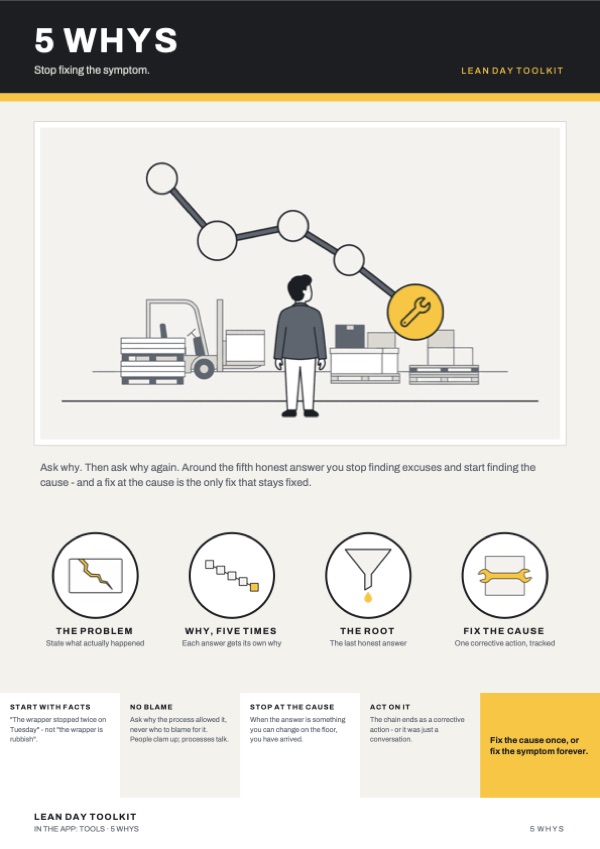
The 5 Whys poster puts the four steps and
the four rules on one A4 page, ending with Fix the cause once, or fix the symptom
forever.
It is free to download, print and use in your own workplace, and it is one of
19 free lean posters. The
A3 poster is the next step for a problem too big
for one chain.
5 Whys in Lean Day Toolkit
Lean Day Toolkit has the 5 Whys under Tools → 5 Whys, and it is one of the tools that stays free. You write the problem, each answer gets its own why, and the chain ends as a corrective action in the app's action list, so the fix is tracked.